Oops! Something went wrong while submitting the form.
To read a commercial cleaning contract, NYC office managers should review the scope of work, cleaning frequency, pricing, exclusions, insurance, and termination conditions before signing.
For instance, an agreement may promise nightly office cleaning without including restroom restocking, interior glass cleaning, or periodic floor care. These tasks may appear in an exclusions section or fall under additional services, sometimes on a separate page. Overlooking a few lines can mean paying extra for services you assumed were included.
Such details can lead to unexpected charges or disagreements once service begins. Pricing also deserves particular attention because the agreement should explain how additional costs and future price adjustments are handled.
For NYC office managers, reviewing the written terms carefully helps establish what the cleaning company must deliver, what falls outside the agreed price, and how service issues or changes will be handled.
This guide examines the key clauses, common warning signs, and questions to ask before committing to help you make the right choice.
Quick Guide: Reading a Commercial Cleaning Contract
A careful contract review can help office managers in NYC avoid unclear responsibilities, unexpected charges, and service disputes. Keep these key points in mind before signing:
Read the full agreement, including attachments and exclusions.
Confirm every cleaning task, area, and service frequency.
Check the agreed price, additional charges, and price-increase provisions.
Verify insurance coverage, staff responsibilities, and building access requirements.
Review complaint procedures, renewal conditions, and termination rights.
Get all service promises and agreed changes documented in writing.
What Is a Commercial Cleaning Contract?
A commercial cleaning contract is a legally binding agreement between a cleaning company and a client. It defines the services to be performed, the agreed price, each party's responsibilities, and the conditions governing the service relationship.
Knowing how to understand a commercial cleaning agreement helps office managers identify what they are paying for and what obligations the cleaning company must fulfill.
A typical agreement covers:
Scope of work: Lists the cleaning tasks included, such as vacuuming, restroom cleaning, trash removal, floor care, and surface disinfection. It also identifies tasks that fall outside the agreed service.
Service schedule: Specifies cleaning days, working hours, and task frequency. Periodic services, such as carpet extraction or floor maintenance, should have separate schedules where applicable.
Payment terms: Explains the contract price, billing cycle, payment deadlines, and charges for additional or out-of-scope work.
Responsibilities: Clarifies who supplies cleaning products and equipment, supervises staff, arranges building access, and handles site-specific requirements.
Performance standards: Describe expected cleaning results, inspection procedures, reporting methods, and how missed or unsatisfactory work will be addressed.
Contract conditions: Establishes the agreement's duration, renewal process, procedures for changing services, and conditions for early termination.
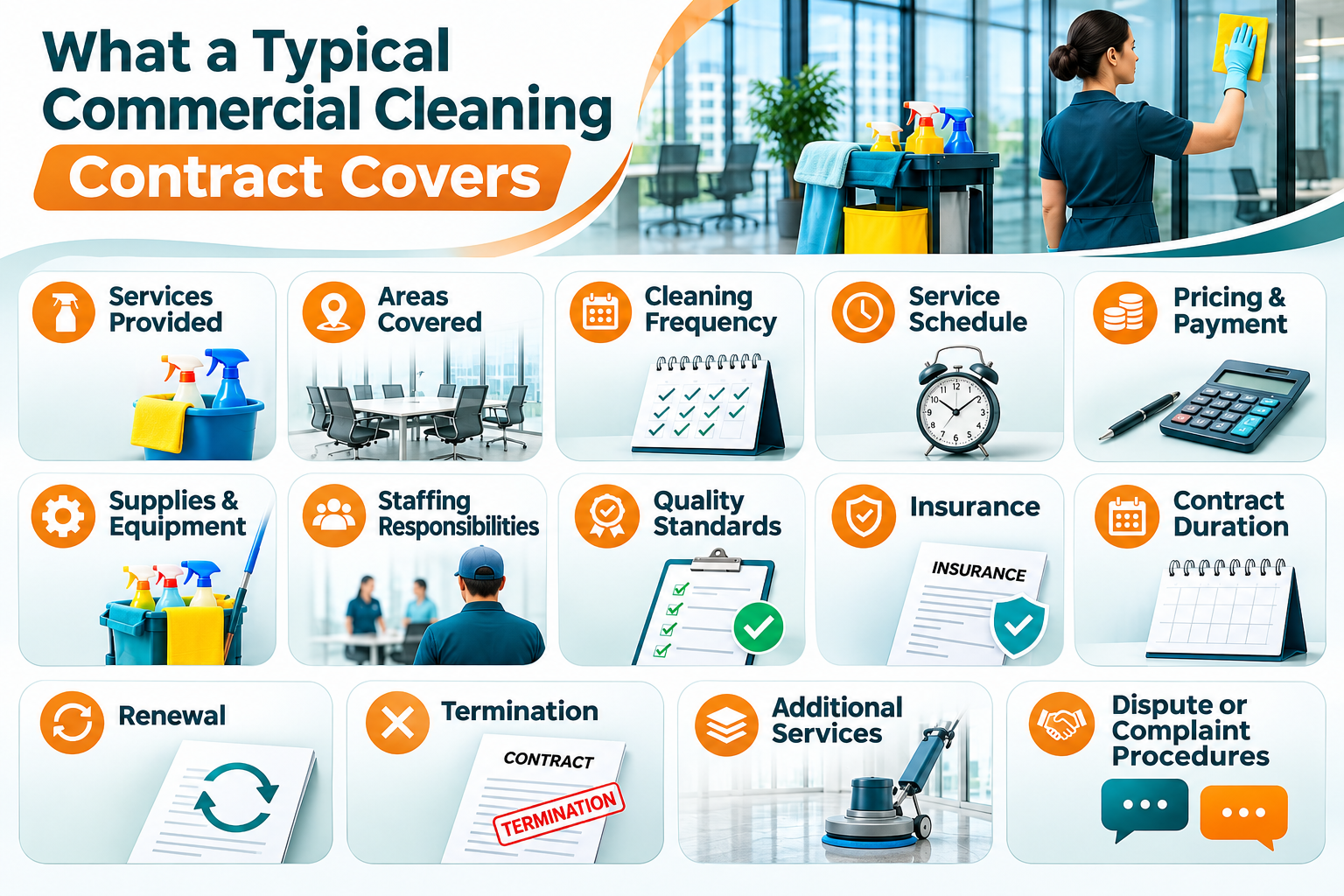
What a Typical Commercial Cleaning Contract Covers
The commercial cleaning contract terms to look for should define the work included, each party's responsibilities, and the conditions governing the service.
Office managers should review the following provisions to understand exactly what the agreement covers.
Services Provided
A description such as "general restroom cleaning" may leave uncertainty about which tasks are included. The agreement should distinguish fixture disinfection, mirror cleaning, floor mopping, and more.
Areas Covered
The agreement should itemize all spaces included in the service, including private offices, conference rooms, kitchens, restrooms, and reception areas. In multi-tenant NYC buildings, confirm whether shared lobbies, elevators, and corridors are included or managed under the property management cleaning services in NYC.
Cleaning Frequency
This clause specifies how often each cleaning task must be completed. For example, restroom cleaning may be required daily, while interior glass cleaning or carpet care may follow a weekly, monthly, or periodic schedule.
Service Schedule
Service Schedule: Identify on which days and at what times cleaning is scheduled. It should state if crews will work during business hours, after closing, overnight, or on weekends and include building access restrictions.
Pricing and Payment
The agreement should state the service price, billing frequency, payment deadlines, and accepted payment methods. Pay particular attention to language allowing additional charges for "special requests" or "services outside the normal scope."
Supplies and Equipment
This clause specifies who supplies cleaning materials, equipment, and consumables such as paper towels and trash liners. OSHA's Hazard Communication Standard requires employers with hazardous chemicals in their workplaces to provide appropriate labels, safety data sheets, and employee training. It's also worth documenting the equipment maintenance and replacement responsibilities.
Staffing Responsibilities
The agreement should outline the cleaning company's responsibilities for assigning, supervising, and replacing staff. Check whether it identifies a site supervisor or contact person and explains how absences and staffing gaps are handled.
Quality Standards
Quality standards define the expected cleaning results and how the company will assess its work. A stronger provision would identify the inspection schedule, the person responsible, the reporting method, and the procedure for correcting missed tasks. A restroom inspection, for example, can check fixture cleanliness, floor condition, waste removal, and replenishment of agreed supplies.
Insurance
The insurance clause specifies the coverage the cleaning company must maintain and any documentation the client requires. Depending on the cleaning company's operations and the building's contractual requirements, these may include Commercial General Liability (CGL), workers' compensation, and other specified coverage. For instance, if cleaning equipment or a cleaner damages a glass partition, the agreement generally explains how to report and address the incident.
Contract Duration
This clause establishes the agreement's effective date and initial term. It should state whether the arrangement lasts for a fixed period, such as 12 months, or continues on a month-to-month basis.
Renewal
The renewal clause explains whether the agreement expires, renews automatically, or requires written approval to continue. Check the renewal period, notice deadline, and any pricing or service changes that may apply. New York office managers should also review General Obligations Law § 5-903 when evaluating automatic renewal provisions.
Termination
This clause outlines the procedures for each party to terminate this agreement. Review the required notice, conditions for early termination, applicable fees, and procedures for addressing breaches or persistent service failures.
Additional Services
The agreement should identify the tasks outside the regular cleaning scope. It may include post-construction cleanup, deep cleaning, or emergency services. You should check how these services are requested, priced, and approved before work begins.
Dispute or Complaint Procedures
This clause sets out how the client can report missed tasks, unsatisfactory work, or other service concerns. It should identify the appropriate contact, explain how complaints are documented, and establish the process for resolving them.
How to Read a Commercial Cleaning Contract Step-by-Step?
Knowing how to review a commercial cleaning contract starts with checking that the written terms align with the services, costs, and responsibilities discussed with the cleaning company.
You should also compare the commercial cleaning quotes with the agreed pricing and service details. This will help you make the right investment towards maintaining your office cleanliness.
Here's how to read a quote step-by-step:
1. Start With the Scope of Work
Compare the scope against your office floor plan and identify any rooms or shared spaces missing from the agreement.
Confirm the cleaning tasks included.
Check which rooms and common areas are covered.
Identify exclusions and separately billed services.
Make sure verbal promises appear in writing.
2. Check the Cleaning Schedule
Review the frequency and timing assigned to each task. General terms such as “regular cleaning” do not establish a measurable service schedule.
Check the cleaning days and working hours.
Confirm how often each task must be completed.
Identify weekend and holiday arrangements.
Clarify how missed visits or schedule changes are handled.
3. Understand the Price Before You Sign
Look beyond the total contract price to understand what the fee covers and when additional charges may apply.
Confirm the base service fee and billing cycle.
Check charges for extra or one-time services.
Review supply and equipment costs.
Identify the conditions for price increases.
4. Review Insurance, Liability, and Security
Check the company's insurance obligations and clarify who is responsible for property damage, staff access, and security procedures.
Verify required insurance types and coverage limits.
Request current certificates and relevant endorsements.
Clarify responsibility for damage or loss.
Check key, alarm, and access-card procedures.
5. See How the Contract Defines Cleaning Quality
The agreement should explain how the company will measure service performance and address work that falls below the agreed standard.
Check inspection and quality-control procedures.
Confirm how missed tasks are reported.
Identify correction timelines.
Clarify who handles service complaints.
6. Read the Contract Term and Renewal Clause
Review how long the agreement remains active and what happens when the initial term ends.
Confirm the start date and contract duration.
Check whether renewal is automatic.
Note the renewal notice deadline.
Review any pricing changes at renewal.
7. Understand How You Can End the Contract
Check the conditions under which either party can terminate the agreement, including early termination.
Identify the required notice period.
Check early termination fees, if any.
Review provisions for breach or repeated service failures.
Confirm final payment and handover requirements.
8. Check How Changes to the Cleaning Service Are Handled
Office requirements can change as occupancy, operating hours, or building use shifts. The agreement should explain how changes to the original scope are approved and priced.
Check how to request additional tasks or coverage.
Confirm whether written approval is required.
Review how revised pricing is calculated.
Clarify when changes take effect.
Common Commercial Cleaning Contract Wording and What It Means
Some contract clauses may sound straightforward but leave important details open to interpretation. NYC office managers should pay attention to vague terms, unclear responsibilities, and conditions that could affect service delivery or costs.
The following examples explain what common contract wording may mean and what to clarify before signing.
Wording in the Agreement
What Office Managers Should Understand
Cleaning as needed
The cleaning frequency and responsibility for determining when work is required may be unclear.
Additional services charged separately
The agreement should specify how extra services are priced and whether written approval is required before work begins.
Periodic quality inspections
The inspection frequency, responsible person, and reporting process need clarification.
Replacement staff provided when necessary.
Confirm whether replacement coverage is guaranteed and how quickly it will be arranged.
Rates subject to adjustment
The conditions for price increases, advance notice, and approval requirements should be defined.
Services performed according to building requirements
The agreement should identify the specific building rules, access restrictions, and cleaning responsibilities that apply.
Commercial Cleaning Contract Red Flags to Watch For
Identifying commercial cleaning contract red flags means checking whether the agreement clearly defines the cleaning company's responsibilities, service expectations, costs, and legal obligations.
A contract may be simple, but it can still be vague about key matters. Comparing the warning signs to what you'd expect in a well-written agreement can enable NYC office managers to spot gaps, ask for clarification, and have those issues addressed before signing.
Red Flag
Why It Matters
Vague scope
Tasks may be missed or disputed.
“As needed” services
Cleaning may become inconsistent.
Unclear exclusions
Unexpected charges or service gaps may arise.
Undefined price increases
Cleaning costs may become unpredictable.
Automatic renewal
You may be locked into another contract term.
No missed-service or corrective-action procedure
Missed cleaning tasks may go unreported or remain unresolved without a clear follow-up process.
Unclear insurance language
Coverage gaps may leave the client exposed.
Verbal promises not in contract
Disagreements may arise over promised services.
Commercial Cleaning Contract Checklist for NYC Offices
Knowing how to check a commercial cleaning contract means verifying that every service, cost, responsibility, and contract condition is clearly documented before signing.
Free Printable Checklist
Commercial Cleaning Contract Checklist for NYC Offices
A practical checklist covering essential cleaning contract terms, service schedules, responsibilities, pricing, and quality standards for NYC offices and commercial facilities — print it.
Learning how often an office should be cleaned can help you assess whether the proposed schedule reflects your office's occupancy, foot traffic, and cleaning requirements.
Use the following checklist to review the agreement and identify missing details.
Scope of Work Is Written Down
The contract should describe each cleaning task included in the agreed service. Avoid relying on general promises such as routine or standard cleaning.
List every recurring cleaning task.
Specify the expected results for each task.
Identify any periodic or specialized services separately.
Every Major Area Is Identified
The agreement should name the rooms and shared spaces covered by the cleaning service so no area is overlooked.
Include offices, conference rooms, reception areas, and restrooms.
Identify kitchens, break rooms, and storage areas.
Clarify whether lobbies, elevators, and corridors are included.
Cleaning Frequency Is Clear
Each task should have a defined frequency based on the office's occupancy, usage, and cleaning requirements.
Specify daily, weekly, or monthly tasks.
Identify periodic services and their intervals.
Avoid vague terms such as "regularly" or "as needed."
Check whether high-traffic areas need more frequent cleaning.
Exclusions Are Listed
In order to avoid misinterpretations and unforeseen fees, the contract must set out the specifics for services and areas excluded from the scope of work.
List excluded cleaning tasks and spaces.
Identify specialized services billed separately.
Clarify how excluded work can be requested and priced.
Schedule Is Defined
The agreement should specify when cleaning will take place and how the schedule will accommodate building operations.
State service days and working hours.
Clarify access arrangements for after-hours cleaning.
Explain how holidays and schedule changes are handled.
Base Price Is Clear
The contract should state the agreed service price and explain what the fee covers.
Specify the monthly or per-visit rate.
Confirm which services are included.
Identify the billing cycle and payment deadline.
Additional Charges Are Explained
Any work outside the regular scope should have a clear pricing and approval process.
Identify services that incur extra fees.
Explain how additional work is priced.
Require approval before out-of-scope work begins.
Supplies Are Accounted For
The agreement should clarify who provides cleaning products, equipment, consumables, and replacement supplies.
Specify whether the company or client supplies materials.
Identify who pays for restroom consumables.
Clarify responsibility for equipment maintenance and replacement.
Price-Change Terms Are Stated
The contract should explain whether and when the cleaning company can adjust its rates.
Identify permitted reasons for price increases.
Specify how much advance notice is required.
Clarify whether changes require written approval.
Insurance Documentation Is Available
Verify that the cleaning company maintains the insurance coverage required by the agreement and can provide supporting documentation.
Request a current certificate of insurance.
Check the stated coverage types and limits.
Confirm any additional insured or endorsement requirements against the actual policy documents.
Access and Security Responsibilities Are Clear
The agreement should establish how cleaning staff will enter the building and protect the premises during service.
Define key, access card, and alarm responsibilities.
Explain visitor sign-in and security procedures.
Clarify how lost keys, access cards, or security incidents are reported.
Quality Standards Are Explained
The contract might make more sense when it describes how there will be an evaluation of the cleaning performance, instead of depending on subjective understanding.
Define the expected cleaning results.
Identify inspection methods and frequency.
Explain how missed or unsatisfactory work will be corrected.
Complaint Procedures Are Defined
A written process helps office managers report service issues and track whether corrective action has been completed.
Identify the contact person for complaints.
Specify how issues should be reported.
Establish response and resolution timeframes.
Contract Term Is Clear
The agreement should state when the service relationship begins and how long the initial contract remains in effect.
Specify the start and end dates.
Identify any minimum service commitment.
Clarify whether the agreement is fixed-term or ongoing.
Renewal Requirements Are Clear
Review how the contract continues after its initial term and whether either party must provide notice to prevent renewal.
Identify the renewal period.
Check the notice deadline for non-renewal.
Confirm whether pricing or service terms change at renewal.
Termination Requirements Are Clear
The agreement should explain when and how either party can end the service relationship.
Identify permitted reasons for termination.
Specify the required notice period.
Check for early termination fees or outstanding payment obligations.
Scope-Change Procedures Are Clear
The contract should explain how changes to cleaning tasks, service areas, or frequency must be requested, approved, and documented.
Require written approval for changes.
Explain how revised services affect pricing.
Specify when approved changes take effect.
Questions to Ask the Cleaning Company Before Signing
A detailed agreement is important, but office managers should also ask the cleaning company how its written commitments will work in practice. Direct questions can reveal gaps in your commercial cleaning contract, staffing procedures, quality control, and additional costs.
If your building needs daytime cleaning support, ask whether day porter cleaning services are available. Knowing how those duties would be included in the agreement can again be quite helpful.
What Exactly Is Included in the Regular Cleaning Service?
Ask the company to explain every recurring task included in the quoted service.
How Often Is Each Task Performed?
Confirm the frequency for individual tasks rather than accepting a general cleaning schedule.
Which Services Cost Extra?
Ask for a list of excluded services and the rates or pricing method for additional work.
Are Cleaning Supplies and Consumables Included?
Clarify who provides cleaning products, equipment, paper products, soap, and other restroom consumables.
How Is Cleaning Quality Checked?
Ask whether supervisors maintain inspection records and how missed tasks are reported and corrected.
What Happens When a Task Is Missed?
Find out how missed tasks are reported, how quickly they are corrected, and who handles follow-up.
Who Will Have Access to Our Office?
Ask how cleaning staff are assigned, supervised, and authorized to enter the building.
Can You Provide Current Insurance Documentation?
Request current insurance documents and confirm that the coverage meets your building's contractual requirements.
How Does the Contract Renew?
Clarify whether renewal is automatic, how long the renewal term lasts, and when notice must be given to prevent renewal.
How Can Either Party Terminate the Agreement?
Ask about termination grounds, required notice, early termination fees, and outstanding payment obligations.
How Do You Handle Employee Background Checks?
Ask what screening procedures apply to employees assigned to your property and whether the company can explain its access-control policies.
What Is Your Process for Emergency or One-Time Cleanings?
Find out how to request urgent or additional cleaning, whether the company can accommodate short-notice requests, and how those services are priced.
Make an Informed Decision for Commercial Cleaning With Sterling Cleaning Services
Knowing how to read a commercial cleaning contract can help NYC office managers make the right investment decision. They will be able to confirm service expectations, understand costs, and avoid unclear responsibilities before committing to a cleaning provider.
At Sterling Cleaning Services NYC, as the most trusted commercial cleaning company in NYC, we facilitate the maintenance needs of professional workplaces. Our team works with businesses and property managers to establish cleaning arrangements that reflect their facility requirements.
Contact Sterling Cleaning Services NYC to discuss your office cleaning needs and request a service proposal tailored to your property.
FAQs
1. What should I look for in a commercial cleaning contract?
When reviewing a commercial cleaning contract, look for a detailed scope of work, clear cleaning schedules, itemized pricing, exclusions, insurance requirements, and termination conditions. The agreement should also explain how missed tasks, complaints, additional services, and price changes are handled.
2. How long does a commercial cleaning contract usually last?
Commercial cleaning contracts can run from one to three years. Some agreements may even go month-to-month or shorter. Make sure to review the start and end dates, renewal terms, and notice requirements before signing.
3. What is the scope of work in a cleaning contract?
The scope of work defines cleaning tasks, areas, and service frequencies included in the agreement. It may also include vacuuming, restroom cleaning, trash removal, dusting, and floor care. Any excluded services should also be listed.
4. What does automatic renewal mean in a cleaning contract?
Automatic renewal is when the contract is renewed on a set basis for another specified term unless one party gives notice within the required time period. Check the renewal date, cancellation deadline, and notice procedure. Certain service contracts in New York may also be subject to statutory renewal-notice requirements.
5. Can you negotiate a commercial cleaning contract?
Yes, you can negotiate the terms of a commercial cleaning contract checklist before signing. Discuss cleaning frequency, included services, pricing, staffing, and termination conditions. Make sure the final written contract includes all agreed changes.
6. What happens if a cleaning company does not complete the agreed work?
If a cleaning company does not complete the agreed work, the client should follow the contract's complaint and corrective-action procedures. Report the missed tasks to the company's designated contact and follow the contract's complaint procedure. The agreement should explain how incomplete work will be corrected and what happens if service problems continue.
7. What insurance should a commercial cleaning company have?
A commercial cleaning company should generally carry Commercial General Liability (CGL) Insurance to cover certain third-party bodily injury and property damage claims. Depending on its operations, it may also need Janitorial Services Liability coverage or relevant endorsements. Care, Custody, or Control (CCC) coverage.
8. How should cleaning frequency be specified in a commercial cleaning contract?
The contract should specify the frequency of each cleaning task separately. For example, restroom cleaning and trash removal may be scheduled daily, while interior glass cleaning or detailed floor care may take place weekly or monthly. Avoid vague terms such as "regular cleaning."
9. What cleaning services are commonly excluded from commercial cleaning contracts?
Common exclusions from commercial cleaning contracts include exterior window washing, high-level cleaning, carpet extraction, floor stripping and refinishing, and post-construction cleanup. These services may require separate pricing, so check the exclusions before signing.
10. Can a commercial cleaning company increase the contract price?
Yes, it can end up being higher if the agreement adds a price increase clause under certain conditions or the parties agree to any changes. Check the reasons for increases, required notice, and approval process before accepting the terms.
11. Can you terminate a commercial cleaning contract early?
Yes, if the agreement allows early termination. You need to check the conditions allowed, the notice period, and the early termination fees. Some contracts can also be canceled as a result of repeated failures to provide the services.
12. What is an SLA in a commercial cleaning contract?
An SLA, or service level agreement, establishes measurable performance expectations for the cleaning company. It may lay down inspection standards, response time limits, and deadlines for making up any work missed.
13. Who is responsible for property damage under a commercial cleaning contract?
Responsibility for property damage under a commercial cleaning contract depends on the proper agreement, the circumstances of the incident, and the law that applies. The agreement should explain how damage claims are handled.
Joseph Sterling
Joseph Sterling is a commercial cleaning professional at Sterling Cleaning Services, sharing practical insights on facility maintenance, healthcare cleaning, infection prevention, and commercial property cleaning standards.
Maintain hygiene and safety with our nursing home cleaning checklist. This blog covers everything from daily to monthly checklists. Stop spreading infections in nursing homes and keep nursing homes clean.
Learn what to look for beyond price when comparing commercial cleaning quotes. Discover how to evaluate service quality, cleaning scope, staff experience, insurance coverage, and contract terms to choose the right cleaning partner for your business.
Figuring out the expense behind office cleaning can seem like cracking a code. It is not just about the price tag, but the value of your office setting. A hygienic office space is a necessity.
Please reach us at any time to set up an appointment to review your commercial cleaning requirements. Sterling will provide an on-site review of your janitorial needs, then create a custom proposal that fits both your specifications and budget